


Sophia Mathioudakis
CASE STUDY ◆ CINCINNATI CHILDREN’S HOSPITAL
Why survivors stop coming back.
UX RESEARCH
journey mapping
healthcare solutions
Designing AI-powered expense management across mobile capture and web review.
ROLE
Project Lead
TIMELINE
1 year
FOCUS
Healthy Equity
NEXT CASE STUDY
Accessible Site for Older Adults
READ MORE ⟶
◆ 05 · SYNTHESIS
From stories to patterns: four themes behind disengagement.
EMOTIONAL AVOIDANCE
The hospital is tied to trauma, so follow-ups get delayed or skipped.
LIFE TRANSITIONS
College and independence disrupt care routines.
MOTIVATION VS. FRICTION
Patients intend to return but lack urgency or support.
LANGUAGE & CLARITY
“Survivorship” isn’t always intuitive or meaningful.
IN THEIR WORDS
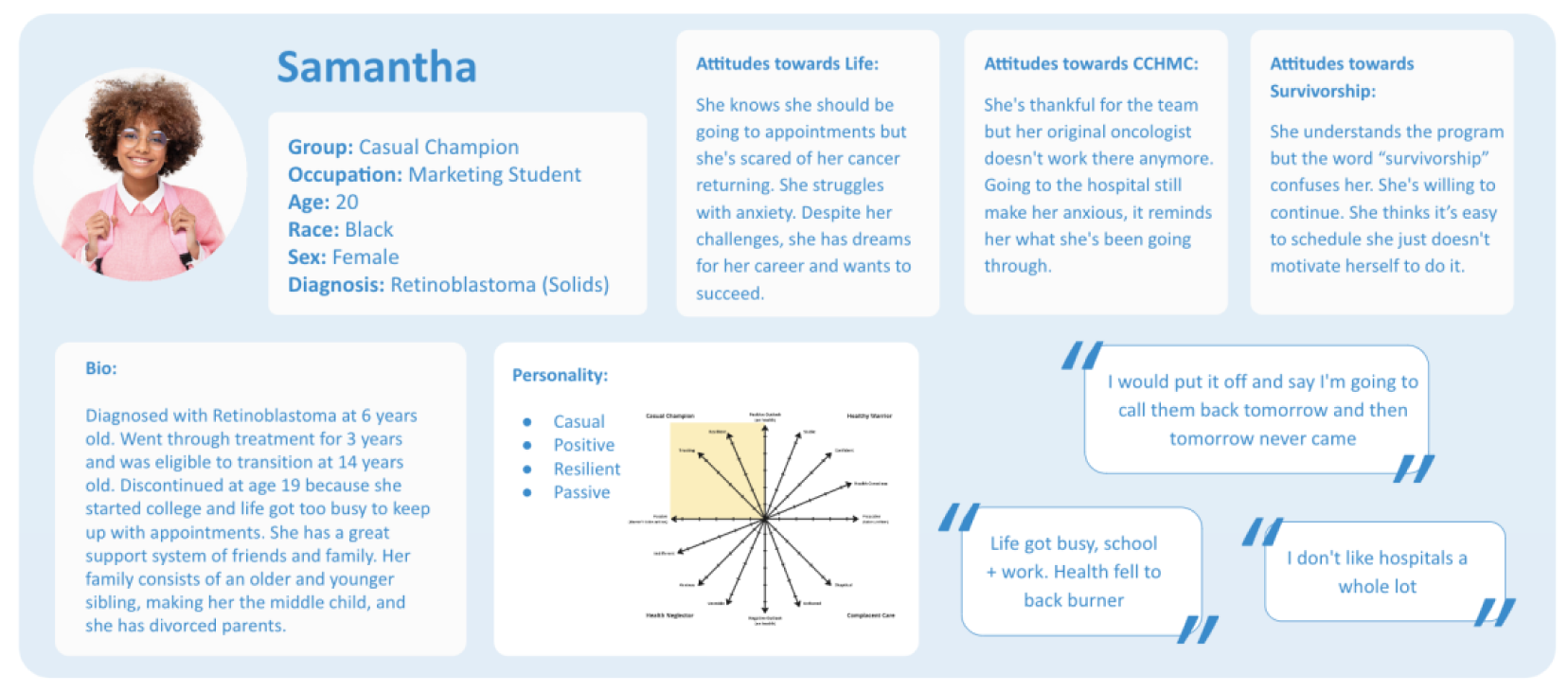
“I would put it off and say I’m going to call them back tomorrow and then tomorrow never came.”
“Life got busy, school + work. Health fell to back burner.”
“I don’t like hospitals a whole lot.”
STEP 06
Personas
Personas grounded in real behaviors and attitudes highlighted differences in motivation and support systems, emotional readiness to re-engage, and equity-related gaps in access.
03
Impact
CHALLENGED ASSUMPTIONS
Revealed the real drivers of disengagement beyond surface-level assumptions.
CENTERED EQUITY
Prioritized underrepresented patient experiences.
A CATALYST
A research-backed foundation for future solution development.
THE QUESTION
How might we design a trusted community platform that empowers users to quickly find relevant information and take control of their care?
01
Background
The Survivorship Center provides lifelong care for pediatric cancer survivors, yet disparities in patient retention — particularly across racial and ethnic groups — revealed gaps in the experience.
OBJECTIVE
Identify and address inequities in the survivorship experience to support long-term engagement and continuity of care.
RESEARCH FOCUS
How patients, especially patients of color, experience survivorship care over time — and what barriers affect continued engagement.
MY ROLE
Helped define research direction across a year-long engagement
Conducted and synthesized qualitative interviews
Led journey mapping and persona development
Translated findings into equitable-design opportunities
02
Process
01
Foundational research
02
Interviews
03
Journey mapping
04
Equity focus
05
Synthesis
06
Personas
STAKEHOLDER INTERVIEWS
01 · Understanding the system
Background research and stakeholder interviews mapped the Center’s structure, clinical workflows and staff perspectives, and surfaced existing assumptions about patient behavior — revealing early gaps between provider expectations and patient realities.
02 · Interviews that challenged our assumptions
WHAT WE ASSUMED
Patients’ challenges could be easily categorized; by talking to a wide breadth of patients, we captured invaluable insights.
WHAT WE LEARNED
Our early assumptions were incomplete or incorrect, which shifted the research direction.
Method: semi-structured interviews for personal storytelling · emotional, logistical and behavioral aspects of care · iterative questioning to probe assumptions.
03 · Journey mapping
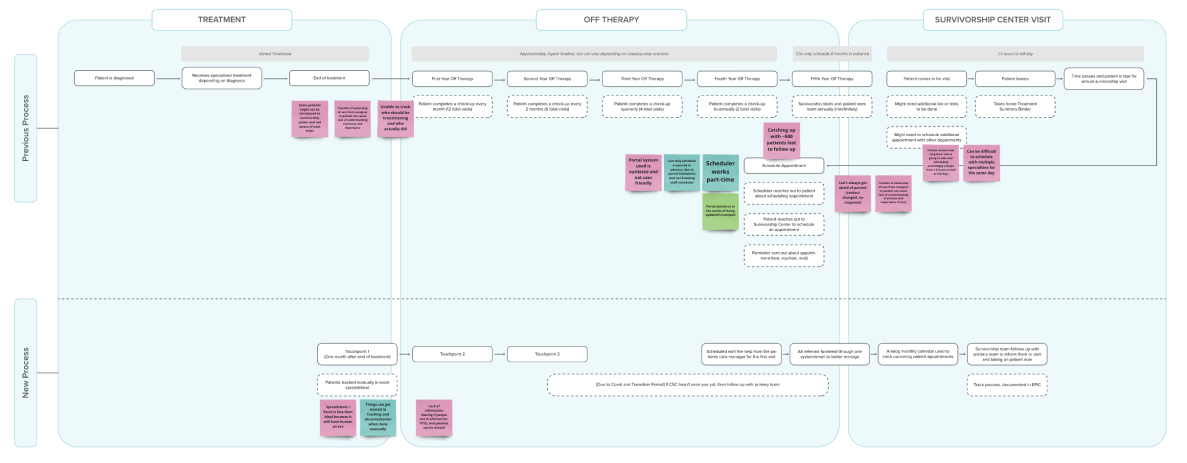
End-to-end patient journeys from treatment completion through survivorship care.
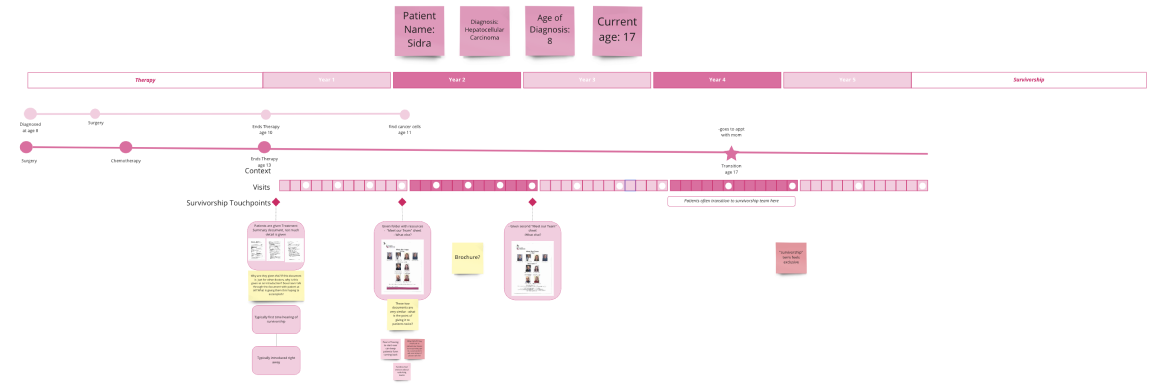
Transition moments
Drop-off points
Emotional highs & lows
04 · Centering underrepresented voices
In later phases we interviewed patients of color specifically, so insights reflected diverse lived experiences — not just majority perspectives. We examined:
• Trust in healthcare systems
• Emotional associations with returning to the hospital
• External pressures: school, work, family
• The language and framing of “survivorship”


Sophia Mathioudakis
Work
About
Resume
CASE STUDY ◆ CINCINNATI CHILDREN’S HOSPITAL
Why survivors stop coming back.
UX RESEARCH
journey mapping
healthcare solutions
Designing AI-powered expense management across mobile capture and web review.
ROLE
Project Lead
TIMELINE
1 year
FOCUS
Healthy Equity

THE QUESTION
How might we design a trusted community platform that empowers users to quickly find relevant information and take control of their care?
01
Background
The Survivorship Center provides lifelong care for pediatric cancer survivors, yet disparities in patient retention — particularly across racial and ethnic groups — revealed gaps in the experience.
OBJECTIVE
Identify and address inequities in the survivorship experience to support long-term engagement and continuity of care.
RESEARCH FOCUS
How patients, especially patients of color, experience survivorship care over time — and what barriers affect continued engagement.
MY ROLE
Helped define research direction across a year-long engagement
Conducted and synthesized qualitative interviews
Led journey mapping and persona development
Translated findings into equitable-design opportunities
02
Process
01
Foundational research
02
Interviews
03
Journey mapping
04
Equity focus
05
Synthesis
06
Personas
01 · Understanding the system
STAKEHOLDER INTERVIEWS
Background research and stakeholder interviews mapped the Center’s structure, clinical workflows and staff perspectives, and surfaced existing assumptions about patient behavior — revealing early gaps between provider expectations and patient realities.
02 · Interviews that challenged our assumptions
WHAT WE ASSUMED
Patients’ challenges could be easily categorized; by talking to a wide breadth of patients, we captured invaluable insights.
WHAT WE LEARNED
Our early assumptions were incomplete or incorrect, which shifted the research direction.
Method: semi-structured interviews for personal storytelling · emotional, logistical and behavioral aspects of care · iterative questioning to probe assumptions.
03 · Journey mapping
End-to-end patient journeys from treatment completion through survivorship care.
Transition moments
Drop-off points
Emotional highs & lows
04 · Centering underrepresented voices
In later phases we interviewed patients of color specifically, so insights reflected diverse lived experiences — not just majority perspectives. We examined:
• Trust in healthcare systems
• Emotional associations with returning to the hospital
• External pressures: school, work, family
• The language and framing of “survivorship”
NEXT CASE STUDY
Accessible Site for Older Adults
READ MORE ⟶
◆ 05 · SYNTHESIS
From stories to patterns: four themes behind disengagement.
EMOTIONAL AVOIDANCE
The hospital is tied to trauma, so follow-ups get delayed or skipped.
LIFE TRANSITIONS
College and independence disrupt care routines.
MOTIVATION VS. FRICTION
Patients intend to return but lack urgency or support.
LANGUAGE & CLARITY
“Survivorship” isn’t always intuitive or meaningful.
IN THEIR WORDS
“I would put it off and say I’m going to call them back tomorrow and then tomorrow never came.”
“Life got busy, school + work. Health fell to back burner.”
“I don’t like hospitals a whole lot.”
STEP 06
Personas
Personas grounded in real behaviors and attitudes highlighted differences in motivation and support systems, emotional readiness to re-engage, and equity-related gaps in access.
03
Impact
CHALLENGED ASSUMPTIONS
Revealed the real drivers of disengagement beyond surface-level assumptions.
CENTERED EQUITY
Prioritized underrepresented patient experiences.
A CATALYST
A research-backed foundation for future solution development.